As we observe Menstrual Hygiene Day 2026, we reaffirm that menstrual health is a foundational pillar of human rights, dignity, and public health. While we are proud of growing policy interest and efforts to transform the global conversation, menstruation remains predominantly framed as a hygiene issue for adolescent girls in schools not as a cross-cutting health, economic, and rights concern and this hinders financial support towards systemic menstrual health management.
Today, menstrual health financing is critically inadequate accounting for less than 1% of total healthcare capital globally with a significant amount of resources channeled towards raising awareness, but awareness without financing is a facade and a blatant disregard of the rights and dignity of over 1.8 billion individuals who menstruate, that’s more than the entire population of Africa, the fastest-growing continent in the world. No other demographic of this scale is ignored in global health financing.
A Region in Crisis: The Cost of Silence
While it is true that across the East and Southern Africa (ESA) region, grassroots initiatives such as training in reusable pad-making for communities have reached millions, these programs often operate with minimal financing, relying on the resilience of youth- and women-led organizations rather than intentional investment.
In regions like Northern Uganda, prone to an influx of refugees, and other humanitarian crisis, the lack of dedicated menstrual health budget lines manifests in displacement camps and climate-affected communities where many are forced to manage their cycles by digging holes in the ground, lacking access to pads, clean water, or basic privacy. Unfortunately, these are documented realities faced by thousands living in refugee settlements and remote island districts where menstrual health remains an invisible line item in national and institutional planning.
The reality is that systemic gaps persist even within progressive menstrual health policy environments like the Republic of Zambia, where “Mother’s Day” policy, a labor law that grants all female employees regardless of their parental status one day of paid leave per month without the need for a medical certificate, is enshrined in the Employment Code Act- a groundbreaking legislation designed to help women manage menstrual pain and biological needs with dignity. While this is exemplary for countries in the ESA region and beyond, the socio-economic burden of menstruation is still among the highest globally owed to high costs of period products.
Absent from the Data
Despite heavy engagement in community health agendas, Menstrual health is entirely absent as an independent, tracked indicator across national health monitoring frameworks. For instance, an assessment of the National Health Strategic Plan (NHSP) Performance Indicator Schedule of the Ministry of Health in Zambia reveals: there is not a single explicit indicator dedicated to tracking menstrual health. Menstrual health remains statistically invisible. If we can’t name it, we can’t fund it.
A landmark regional review, Menstrual Health Management in East and Southern Africa, reveals that this lack of empirical baseline monitoring acts as the primary bottleneck to financing. Until national health institutes treat menstrual health as a foundational public health indicator, resource mobilization will remain locked in a cycle of reactive gestures, failing to capture the immense socioeconomic dividend of a fully funded, gender-responsive framework.
Name It, Fund It
We must become comfortable with the vocabulary of menstruation, because if parents, leaders and decision makers cannot comfortably name the challenge, how can it be adequately funded? Menstruation is not a dirty word. It is not a secret. But if the people who decide what gets funded remain too ashamed to say the word, the silence will continue to sponsor the crisis.
Additionally, short grant cycles do not solve a recurring monthly biological need. Complex reporting requirements by global financiers burden small organisations led by women and youth already managing programmes with minimal resources. And the assumption that there is no community money for menstrual health is simply wrong, communities must be guided on how they can show support. In 2025, Dwona Initiative in Uganda ran a “Periods Are Power” art exhibition and raised over $8,000 USD in a few hours, a figure that can keep over 700 girls in school for a full year. If 82 people in a community can finance periods, governance ecosystems have no excuse to name the issue and fund it from a systems based approach.
Call to Action: Five Clear Asks for a #PeriodFriendlyWorld
- Name it, Fund it: Governments across East and Southern Africa and beyond must integrate explicit menstrual health indicators into national health data and establish dedicated budget lines because what remains institutionally unnamed will remain underfunded.
- Shift Capital to the Grassroots: Global donors and financiers must simplify application processes and commit to multi-year funding for the small, women-led organizations that are delivering regional solutions on the frontlines with minimal resources.
- Invest in Community-Driven Finance: Communities and local stakeholders must participate in and finance menstrual health, understanding that a simple $12 investment can supply period products to keep 1 girl in school for a full year.
- Demand Leadership Accountability and Policy Reform: Women in leadership positions must leverage their platforms to champion policy changes such as the complete elimination of regressive taxes on menstrual products to ease the 15% income burden faced by women in the ESA region and beyond, while demanding responsive facility infrastructure.
- Mandate Menstrual Equity in Humanitarian Response: Emergency response bodies must make dignified menstrual health management a non-negotiable, ensuring that displaced individuals are never overlooked at the expense of their dignity.
As we look toward a #PeriodFriendlyWorld, let us keep in mind the economic cost of our silence. Closing this health gap could generate trillions in global GDP. Investing in menstrual health means a girl finishes school. A woman participates economically and communities manage their own dignity. This is possible!
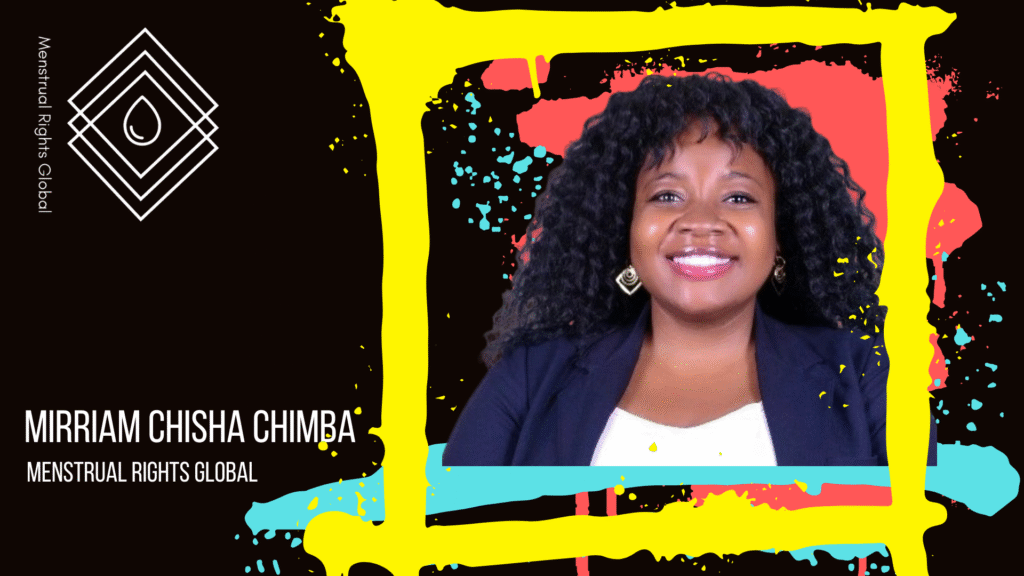
Mirriam Chisha Chimba is a communications specialist and resource mobilisation consultant with fifteen years of experience across 20+ youth- and women-led organisations in East and Southern Africa. She is a Global Health Corps Alumna, MBA Candidate at Edinburgh Business School (Heriot-Watt University) on a Scottish Government Gender Equality Scholarship, and an advocate for menstrual health, gender equity, and community-led global health financing.