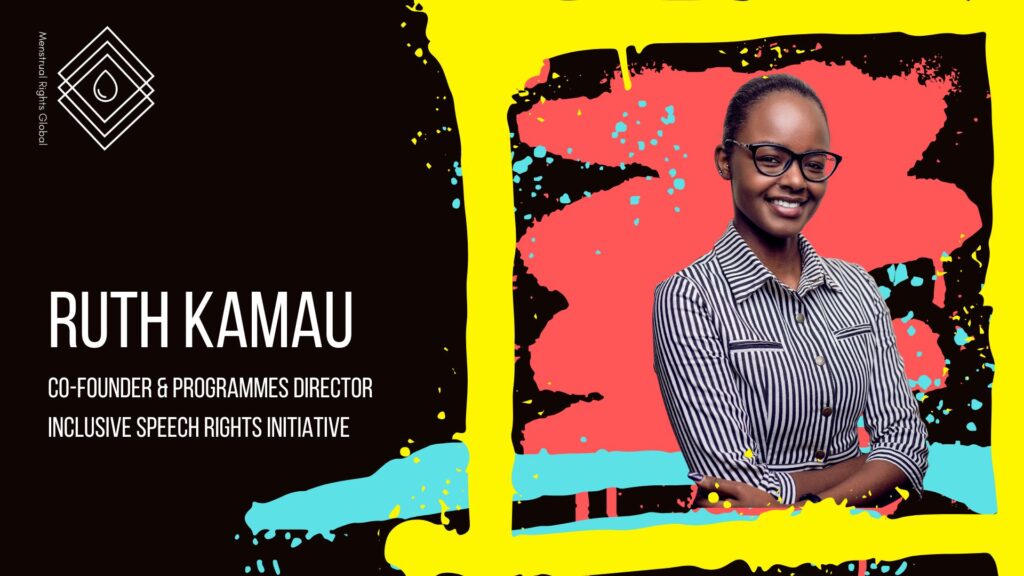
Co-authors:
Ruth Kamau, Co-founder and Director, Inclusive Speech Rights Initiative, Kenya
Pamela Wango, Program Coordinator, Federation of Deaf Women Empowerment Network
On Menstrual Hygiene Day 2026, conversations around menstrual health continue to gain long overdue visibility across global health, education, gender equality, climate, and human rights agendas. Increasingly, there is recognition that menstruation is not solely a health issue, but one intrinsically connected to dignity, participation, education, economic opportunity, bodily autonomy, and social justice across the life course. This progress matters enormously.
Despite growing political recognition, many people remain systematically excluded from the conversations shaping menstrual health policy, financing, programming, and governance in the first place. Among the most consistently overlooked are persons with disabilities.
When disability is discussed within menstrual health spaces, the conversation frequently becomes narrowly framed around accessibility and accommodation. Discussions often focus on accessible toilets, adapted menstrual products, caregiver support, or menstrual education for persons with intellectual disabilities. These issues are important and long overdue for investment. Limiting the conversation to technical accommodation, though, risks obscuring a much larger structural issue: disabled people remain too often absent from the rooms where global health, humanitarian, climate, and development priorities are designed, negotiated, and funded.
This exclusion has significant consequences because disability is not a singular or homogenous experience. Disability encompasses a broad spectrum of physical, sensory, intellectual, speech, psychosocial, neurodivergent, and chronic health conditions, all of which intersect differently with menstruation, poverty, gender inequality, healthcare access, sanitation infrastructure, education, geography, displacement, and social norms.
A girl with cerebral palsy navigating menstruation within a low resource rural setting may encounter entirely different barriers from an autistic adolescent in an urban school environment, a Deaf woman accessing sexual and reproductive healthcare, or a displaced woman with visual impairment living within a humanitarian crisis. Each experience is shaped not only by impairment, but by the interaction between social systems, infrastructure, policy environments, economic inequality, and cultural norms. Treating disability as though it represents one universal category of need inevitably produces policies and programmes that fail to account for the complexity of lived experience.
These realities become even more pronounced when viewed through the lens of global inequity and climate vulnerability. Climate related disasters, displacement, flooding, disrupted sanitation systems, and pressure on already fragile health infrastructure disproportionately affect disabled populations, who remain among the groups most excluded from humanitarian planning and emergency response globally. Disability perspectives nevertheless remain strikingly underrepresented within climate adaptation and resilience discussions, including those linked to sexual and reproductive health and rights. Even within spaces committed to advancing equity and inclusion, disability is frequently treated as a secondary consideration rather than recognised as fundamental to how systems themselves are designed.
Part of the problem lies in the way inclusion is conceptualised across global health and development systems. Disabled people are commonly framed as vulnerable populations to be reached, rather than as leaders, experts, policymakers, researchers, practitioners, and advocates who should be shaping agendas directly. Many menstrual health policies consequently continue to be developed through institutional processes that remain socially and politically distant from the realities they seek to address. Representation becomes symbolic rather than structural.
This matters because menstrual health is not solely a question of product access or hygiene management. Menstrual experiences are shaped by wider systems including healthcare access, sanitation infrastructure, social protection, public policy, education systems, gender norms, transport, housing, employment conditions, digital access, and community support structures. Disability intersects with all of these determinants simultaneously.
A technically accessible intervention implemented within an exclusionary system may still fail if wider political, economic, and social barriers remain intact. Accessible toilets alone will not address exclusion from education systems. Adapted products alone will not resolve inaccessible healthcare systems, gender discrimination, transport inequities, poverty, or exclusion from policymaking processes. Menstrual justice therefore requires a systems approach rather than isolated interventions.
Disability inclusion must also move beyond narratives that position disabled people exclusively through vulnerability and dependency. Across global health and rights movements, disabled advocates, practitioners, researchers, and community leaders have long advanced critical work on sexual and reproductive health, gender justice, accessibility, technology, and systems reform. These voices nevertheless remain consistently underfunded, underrepresented, and insufficiently integrated into mainstream governance and policy spaces. This weakens not only equity, but also the quality and sustainability of policy itself, since interventions designed without meaningful lived experience frequently overlook the realities shaping implementation and access.
Research examining scholarly work on menstrual health and disability illustrates the scale of this exclusion. Of 35 papers identified outside of guidelines, strategies, or policy documents, only seven directly consulted persons with disabilities or their caregivers. Policies and interventions continue to be developed about disabled communities without being developed meaningfully with them.
Exclusion also operates beyond institutional structures. Persons with disabilities are often less likely to participate in community decision making, meaning their perspectives on menstrual health, sanitation, and healthcare may remain unheard even at local levels. Stigma can operate externally through discrimination from peers, institutions, and communities, while also becoming internalised through self stigma that limits participation and visibility. Meaningful systems change cannot occur while people remain excluded from defining the issues shaping their own lives.
At its core, this is a question of political participation and power.
The United Nations Convention on the Rights of Persons with Disabilities establishes the active involvement of persons with disabilities in decisions affecting their lives as a legal and human rights obligation. Article 4(3) explicitly states that persons with disabilities must be closely consulted and actively involved in the development and implementation of legislation and policies through their representative organisations. This principle extends directly into menstrual health policy, advocacy, financing, governance, and implementation.
Marginalised groups cannot transform systems while remaining excluded from agenda setting, leadership, and political participation. Persons with disabilities must not simply be positioned as beneficiaries of menstrual health interventions, but as central actors shaping the priorities, concepts, policies, financing structures, and systems governing menstrual health itself.
The conversation must also recognise the role of assistive technologies in strengthening participation and advocacy. Policy engagement relies heavily on communication, negotiation, caucusing, and consensus building. Persons with disabilities with non standard speech may therefore encounter additional barriers in participating effectively within policymaking and advocacy spaces, including those related to menstrual health.
Assistive technologies play a critical role in bridging this gap. These technologies, whether digital or physical, help maintain or improve an individual’s communication, functioning, independence, and participation. Global health institutions increasingly recognise assistive technology as central to the attainment of the rights of persons with disabilities. Within menstrual health policy and advocacy spaces, investment in assistive technologies is not peripheral to inclusion. It is fundamental to ensuring participation, representation, and political voice.
Meaningful inclusion therefore requires far more than inserting references to disability within strategies, frameworks, or consultation processes. It requires a redistribution of power across global health and development systems themselves. This includes funding organisations led by persons with disabilities, embedding disability leadership within governance structures, ensuring conferences and policymaking spaces are genuinely accessible, improving disability disaggregated data, investing in assistive technologies, and recognising disability as central to health systems strengthening, humanitarian response, climate resilience, gender equality, and social development agendas rather than peripheral to them.
The growing visibility of menstrual health within international policy discussions represents important progress. Progress cannot simply be measured through whether disability is mentioned within frameworks or strategies. The more important question is whether disabled people are meaningfully shaping the agendas themselves.
On Menstrual Hygiene Day 2026, global health systems must move beyond symbolic inclusion toward structural transformation. Inclusive menstrual health across the life course cannot be achieved while disabled people remain excluded from leadership, governance, financing, and policy design.
Menstrual justice is not simply about products or hygiene management. It is about dignity, participation, rights, leadership, equity, and political power.
Disability inclusion must therefore be understood not merely as accommodation, but as leadership, participation, and decision making authority. Without that shift, global health conversations will continue to reproduce many of the inequities they claim to address.
References
House, S., Mahon, T. and Cavill, S. (2012). Menstrual hygiene matters: A resource for improving menstrual hygiene around the world. London: WaterAid.
House, S. (2013). Menstrual hygiene matters in emergency contexts. London: WaterAid.
Love, H., MacKinnon, K. and Nevin, A. (2017). The Convention on the Rights of Persons with Disabilities and participation in policymaking. Disability and Society.
Mena, A. (2015). Disability, stigma and participation in community life. Journal of Social Inclusion.
Smith, E.M. (2024). Assistive technology and the rights of persons with disabilities: Global policy perspectives. World Health Organization Global Cooperation on Assistive Technology.
United Nations. (2006). Convention on the Rights of Persons with Disabilities. New York: United Nations.
United Nations Office for Disaster Risk Reduction (UNDRR). (2021). Global Assessment Report on Disaster Risk Reduction. Geneva: UNDRR.