Our Toolkits

We co-create practical tools across our global network through a participatory co-design process. Each resource is grounded in the priorities, expertise and lived experience shared by our partners through in-person discussions, workshops and ongoing collaboration.

Tools for menstrual health advocacy and action

Menstrual Rights Global co-creates practical tools with communities, advocates, researchers and institutional partners to strengthen advocacy and build more connected ecosystems across health, climate, human rights, gender equality and sexual and reproductive health and rights.

Our tools support practitioners, policymakers, educators, activists, youth leaders and development partners to understand and address the discrimination, stigma and structural inequalities that shape menstrual experiences. They are designed to help users move beyond narrow approaches focused only on products, facilities or menstrual management and towards rights-based, intersectional and context-specific action.

Menstrual discrimination can appear through silence, stigma, restriction, exclusion and deprivation across households, schools, workplaces, healthcare systems, humanitarian settings, public institutions, legal frameworks and the media. Addressing it requires us to examine the relationships between gender, power, disability, race, age, sexuality, poverty, geography, climate vulnerability and other intersecting forms of inequality.

During the 78th session of the United Nations General Assembly, Menstrual Rights Global convened a hybrid workshop in partnership with UNFPA’s Sexual and Reproductive Health Division to map the future of menstrual health as a human rights issue. The insights and recommendations generated through this process have informed our wider policy and advocacy work and are available on our Policy page.

Building a shared understanding

Clear and inclusive language is essential to effective menstrual health advocacy. These definitions provide a common foundation for using the tools and resources on this page.

What is menstruation?

Menstruation, commonly called a period, is the shedding of the uterine lining through vaginal bleeding as part of the menstrual cycle.

It is a normal biological process, but menstrual experiences vary between individuals and across the life course. Periods may not occur monthly or regularly and can involve a range of physical, mental, emotional and social experiences.

Women and girls are disproportionately affected by menstrual inequality and discrimination. Transgender men, non-binary people and other gender-diverse people may also menstruate and can face additional barriers to information, facilities, healthcare and support.

What is menstrual health?

Menstrual health is a state of complete physical, mental and social well-being in relation to the menstrual cycle, rather than only the absence of illness, pain or discomfort.

Achieving menstrual health means that everyone who menstruates can:

  • access accurate, timely and inclusive information;
  • understand and care for their body with dignity;
  • access appropriate healthcare and support;
  • use suitable menstrual materials and safe water, sanitation and disposal facilities;
  • participate fully in education, employment, community and public life;
  • make informed decisions about their health and body; and
  • live free from stigma, discrimination, exclusion, violence and harmful restrictions.

Menstrual health is an integral part of sexual and reproductive health and rights. It is also connected to the rights to health, education, water and sanitation, work, bodily autonomy, equality, non-discrimination and meaningful participation.

A rights-based approach therefore goes beyond improving menstrual management. It examines and challenges the social norms, institutional practices, unequal power structures and policy barriers that sustain menstrual discrimination.

Using the toolkit

The resources on this page can help individuals and organisations to:

  • analyse menstrual health through gender, power, intersectionality and human rights;
  • integrate menstrual health into policy, programme and strategy development;
  • strengthen advocacy, communications and leadership;
  • support meaningful engagement with communities and people with lived experience;
  • develop monitoring, evaluation and learning approaches;
  • identify indicators for rights-based menstrual health initiatives;
  • engage governments, funders and institutional partners;
  • connect menstrual health with climate, health, education, humanitarian action and gender justice; and
  • develop context-specific action plans.

The tools can be adapted across countries, communities and institutional settings. Users should avoid assumptions about what people need and meaningfully involve those most affected in the design, delivery, governance and evaluation of menstrual health policies and programmes

Menstrual health and climate policy papers and toolkits

We co create practical tools across our global network through a participatory co design process. Each resource is grounded in the priorities, expertise and lived experience shared by our partners through in person discussions, workshops and ongoing collaboration.

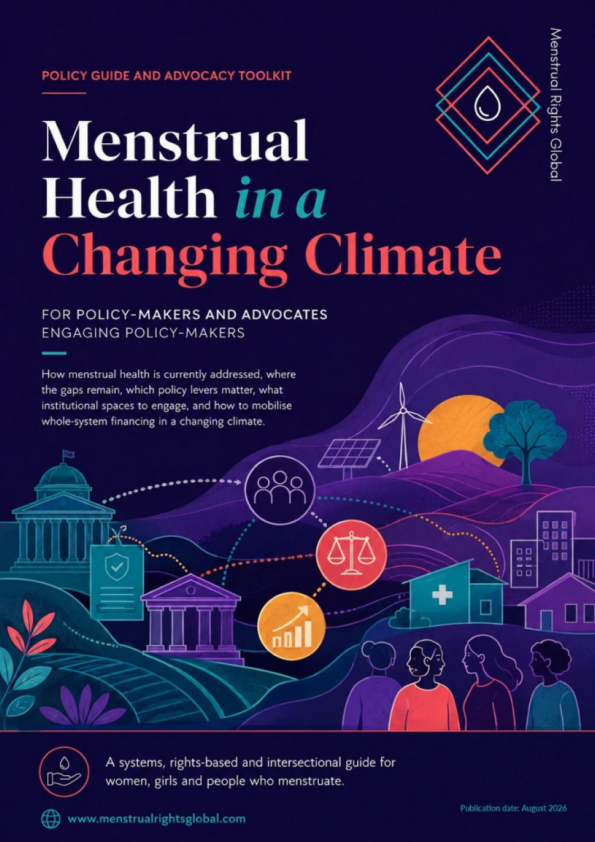
Menstrual Health in a Changing Climate

Climate change is making it harder for millions of people to manage menstruation safely and with dignity. Extreme heat, flooding, water insecurity, displacement, disrupted health services and economic shocks are exposing the weaknesses of systems that were already failing women, girls and people who menstruate.

Yet menstrual health remains largely absent from climate policy, financing and preparedness. Menstrual Health in a Changing Climate moves beyond a narrow focus on products and emergency provision. It shows how menstrual health is shaped by decisions across health, WASH, education, employment, social protection, infrastructure, humanitarian action and public finance, and provides practical routes to change.

This is not a niche issue. It is a test of whether public systems can protect health, rights, dignity and participation in a changing climate.

Full Policy Guide and Advocacy Toolkit

The complete systems-based guide to menstrual health in a changing climate, including policy analysis, financing principles, implementation pathways and practical tools.

Downlaod the full report

Toolkit for Advocates

A practical guide for engaging policy-makers, building coalitions, identifying policy entry points, making clear asks and holding institutions accountable.

Download the toolkit for advocates

Toolkit for Policy Makers

A six-step framework for integrating menstrual health into climate policy, programmes, public systems and budgets.

Download the toolkit for policy makers

1. Educate yourself and teach others

Start by reading the reports and our mission page to know more about period poverty during the covid-19 pandemic and share your knowledge with others so more people can join the movement.

2. Start a conversation

to eliminate the stigma surrounding menstruation and period poverty the first step is to start talking about it. Spark up a conversation about menstruation, menstrual health and period poverty or  share our social media posts and graphics. this is a way to get more people to join the conversation and advocate for change.

3. Advocate for change

Write a letter to your local government or tweet asking for menstrual health to be prioritised during the pandemic.

We must avoid making assumptions about what people need, so we work with various stakeholders to co-develop tools, events, and advocacy initiatives that grassroots activists can adopt.

Direct Action! Write to your government.

You can download a template letter for your government in French, English or Spanish to send to your Minister of Health, Minister of Equality, Minister of Women, or Local Councilor, asking them to prioritise menstrual health policies.

We have also curated several global discussions focusing on the intersection of menstrual health and several prominent international health topics, such as universal health coverage, gender based violence, human rights, and women’s leadership. You can watch these events on our YouTube channel.

Educate yourself and teach others

Start by reading the reports and our mission page to know more about period poverty during the covid-19 pandemic and share your knowledge with others so more people can join the movement.

Start a conversation

to eliminate the stigma surrounding menstruation and period poverty the first step is to start talking about it. Spark up a conversation about menstruation, menstrual health and period poverty or  share our social media posts and graphics. this is a way to get more people to join the conversation and advocate for change.

Advocate for change

Write a letter to your local government or tweet asking for menstrual health to be prioritised during the pandemic.

We must avoid making assumptions about what people need, so we work with various stakeholders to co-develop tools, events, and advocacy initiatives that grassroots activists can adopt!

You can download a template letter for your government in French, English or  Spanish to send to your Minister of Health, Minister of Equality, Minister of Women, or Local Councillor, asking them to prioritise menstrual health policies.

We have also curated several global discussions focusing on the intersection of menstrual health and several prominent international health topics, such as universal health coverage, gender-based violence, human rights, and women’s leadership. You can watch these events on our YouTube channel.