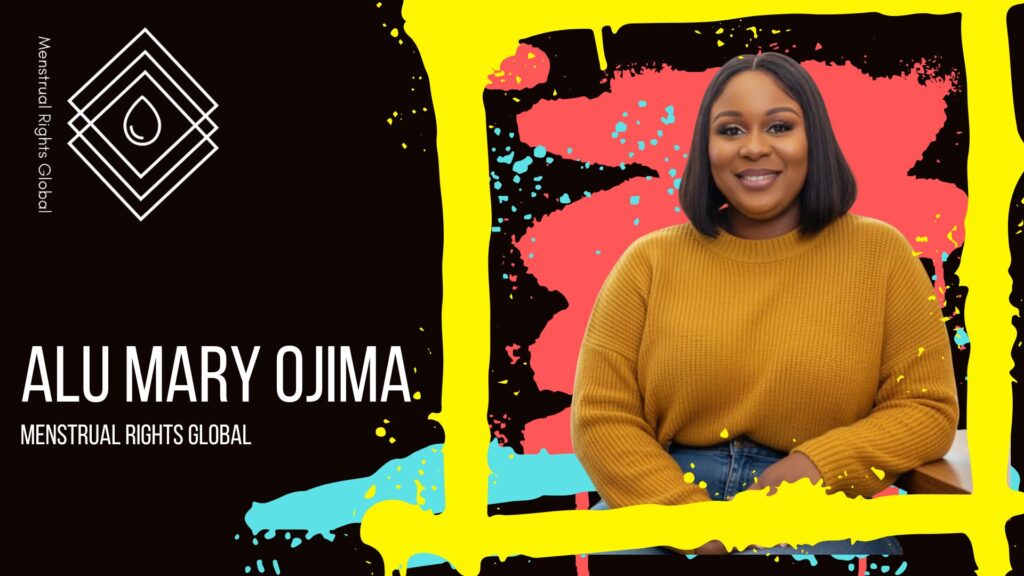
Alu Mary OJima
To promote a #PeriodFriendlyWorld for Menstrual Hygiene Day 2026, Alu Mary Ojima reflects on how the silence surrounding menstruation begins in childhood and continues to shape confidence, relationships, education, and participation in society. Through personal reflection and social commentary, she explores the psychological impact of stigma, the consequences of exclusionary norms, and the urgent need for a cultural shift that normalises menstruation within homes, schools, workplaces, and public life. Her piece calls for a future where menstrual health is recognised not as a private shame, but as a fundamental issue of dignity, equity, health, and human rights.
I still remember the day I had my first period. My mother was with me, guiding me through how to use a pad. Just as we were talking, my father walked in. Instantly, my mother went silent. When my father asked what was happening, she brushed it off,
“No problem.”
That moment etched something in me: periods were not to be discussed in front of men. They were private, hushed, almost shameful.
Years later, I realized that early encounter laid the foundation for much of my experience with
menstruation and puberty: confusion, anxiety, and secrecy. The message I internalized was clear, menstruation is something private, to be hidden, and certainly not to be openly discussed.
This mindset made me hesitant to ask questions, seek guidance, or share experiences even with friends who were going through the same thing. It was a lonely introduction to a natural part of life, one that affected not just how I saw my body, but how I interacted with the world around me. Over time, this silence created layers of uncertainty: wondering if what I felt was normal, if my questions were inappropriate, or if I should hide everything about my body from those around me.
Recently, in Nigeria, a conversation on Twitter illustrated how deeply this culture of silence and shame has permeated society. A man tweeted about menstruation in a way that implied women should not speak openly about it. The responses were incredible, women collectively challenged him, emphasizing that periods are not shameful, that menstruation is not solely a “woman’s issue, ” and that the silence around it has real societal and governance implications.
Observing this exchange, I was struck by how adolescent lessons we absorb at home echo into adulthood and shape societal norms. What begins as whispered instructions from a mother can ripple outward, influencing public perceptions and even policy discussions.
The Psychology Behind the Hush
Psychologists often say that our earliest social lessons come from family interactions. When a child repeatedly receives a signal, spoken or unspoken, it shapes how they perceive reality. In the case of menstruation, repeated silence, avoidance, or shaming messages build a lasting internal belief: “this is something bad. ”
Research supports this. Studies across sub‑Saharan Africa show that up to 65% of adolescent girls report feeling embarrassed when they menstruate because of cultural taboos and silence at home. Many girls avoid school during their periods, not because of pain alone, but because they fear stigma from boys, teachers, and even family].
This hush is not just cultural, it is psychological. Social learning theory tells us that repetition forms identity. Just as a child learns her name through repeated reinforcement, she also learns shame when her environment consistently reinforces it. Over time, this internalised shame can affect confidence, relationships, and willingness to advocate for oneself. It can shape career choices, comfort in seeking healthcare, and even the ability to participate fully in social or civic
life.
The Consequences of Silence
The consequences are far-reaching: At home: Girls are often taught about periods only by their
mothers, if at all. Fathers remain absent from the conversation. Studies indicate that in many African contexts, less than 20% of fathers engage in menstrual health discussions with their daughters. Without both parents involved, children often receive partial or misleading information, reinforcing the sense of secrecy.
At school: Many girls shy away when boys are present during menstrual education sessions. A
UNICEF report highlights that stigma leads to 1 in 10 African girls missing school during
menstruation . This disruption affects academic performance, long-term confidence, and
opportunities for future education.
In society: The taboo extends to adulthood, influencing women’s comfort in workplaces,
relationships, and healthcare settings. Silence at home becomes silence in society, and the
patterns of shame are perpetuated in professional and social spaces.
For some girls, especially those living with single fathers or in child‑headed households, this silence can be dangerous. Without guidance, they resort to unsafe practices such as using rags, paper, or even mud to manage menstruation, leading to infections and long-term health
risks]. The consequences are not just immediate discomfort but also potential chronic
reproductive health problems that can have lifelong implications.
Why We Need a Paradigm Shift
To dismantle centuries of taboo, we must address the psychology behind it. Changing mindsets is not about a one-off health talk; it is about repeated, normalised conversations.
If a child is told only once that menstruation is normal, she may forget, but if she hears it
constantly, from her mother, her father, her teachers, and even her peers, it becomes part of
her identity. Just like learning a name, it takes repetition. That is the shift we need: Fathers should be included in the conversation, actively participating in educating their children. Boys should learn about menstruation alongside girls, so they grow up to be informed and supportive partners.
Schools should normalise period education as part of life, not as a special “girls-only” whisper.
Society at large should dismantle the stigma by encouraging open discourse about
menstruation, holding public figures accountable, and ensuring policies support menstrual health access.
Towards a Future Without Shame
Imagine a generation where a girl does not flinch if her father buys her pads, where boys understand menstruation as a biological fact, and where teachers openly create safe spaces for menstrual education.
Imagine a society where men and women can discuss menstruation without embarrassment, where workplaces provide the support needed for menstrual health, and where governance recognises menstrual health as a human rights and development issue. The pathway to this
The future begins with breaking the silence at home, then extending to schools, communities, and public spaces. Every conversation, every lesson, every normalisation of menstruation chips away at decades of shame and misunderstanding.
The truth is this: menstruation is not a secret, not a shame, not a taboo. It is life itself,
and it deserves to be treated with the respect, knowledge, and openness it warrants.
This Menstrual Hygiene Day, let us move beyond silence and stigma towards a world where every person can experience menstruation with dignity, knowledge, safety, and support.