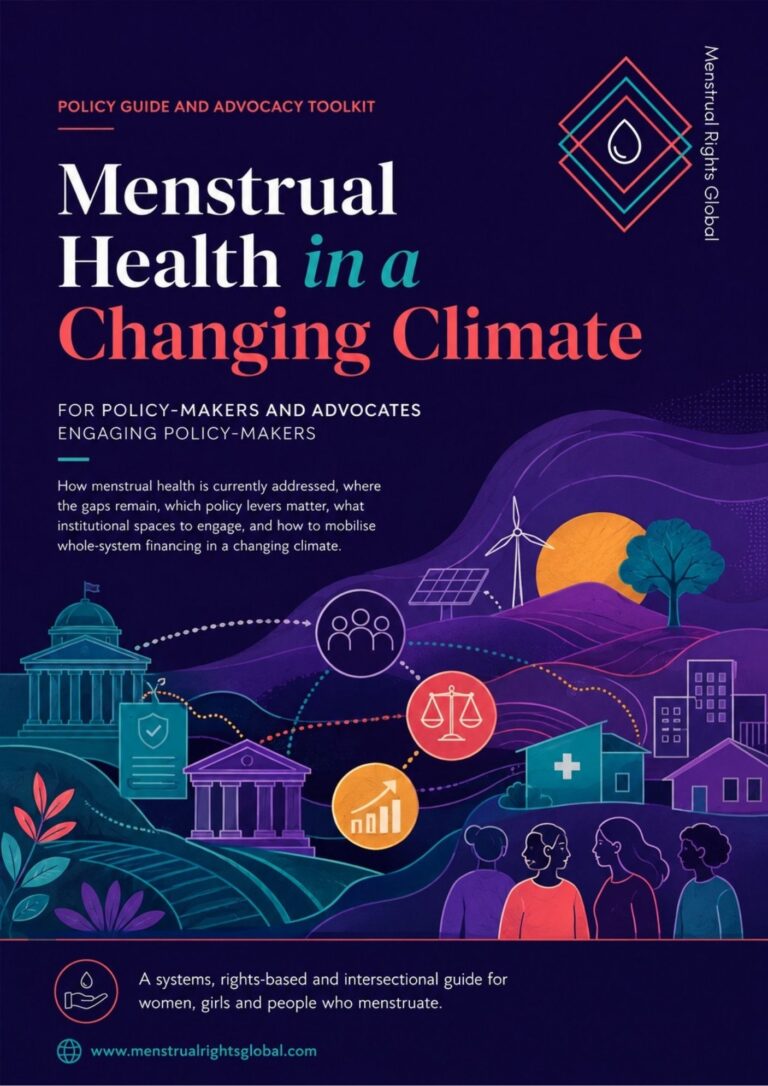
Toolkit
We co-create tools with actors to support advocacy efforts & build stronger ecosystem across health, climate, & rights.
Menstrual Rights Global held a hybrid workshop in partnership with the UNFPA SRH Division on the sidelines of the 78th session of the United Nations General Assembly to roadmap the future of menstrual health as a human rights issue. The insights from this workshop can be found on our policy page.
What is menstruation/a period?
What is period poverty?
We understand that several terms are used interchangeably within this sector, each with its strengths and weaknessesPeriod poverty is a paradoxical term whereby its use further perpetuates the stigma and shame relating to sub-optimal menstrual health. The time emerged from the global north but has gained traction in the global South.
Our definition is based on the Action Aid (2021) definition. Period poverty affects women, girls and individuals that menstruate worldwide. Access to appropriate and safe period products, safe and hygienic spaces to use them, and the right to manage menstruation without shame or stigma are essential for menstruating.
What is menstrual health?
In a recent publication, Menstrual Health was defined as complete physical, mental, and social well-being and not merely the absence of disease or infirmity about the menstrual cycle. It is also a facet of sexual and reproductive health rights (SRHR). According to the United Nations, SRHR are the right to life, liberty and the security of the person; the right to health care and information; and the right to non-discrimination in allocating resources to health services and their availability and accessibility.
1
educate yourself and teach others
Start by reading the reports and our mission page to know more about period poverty during the covid-19 pandemic and share your knowledge with others so more people can join the movement.
2
Start a conversation
to eliminate the stigma surrounding menstruation and period poverty the first step is to start talking about it. Spark up a conversation about menstruation, menstrual health and period poverty or share our social media posts and graphics. this is a way to get more people to join the conversation and advocate for change.
3
Advocate for change
Write a letter to your local government or tweet asking for menstrual health to be prioritized during the pandemic.

Educate yourself and teach others
Start by reading the reports and our mission page to know more about period poverty during the covid-19 pandemic and share your knowledge with others so more people can join the movement.

Start a conversation
to eliminate the stigma surrounding menstruation and period poverty the first step is to start talking about it. Spark up a conversation about menstruation, menstrual health and period poverty or share our social media posts and graphics. this is a way to get more people to join the conversation and advocate for change.

Advocate for change
Write a letter to your local government or tweet asking for menstrual health to be prioritised during the pandemic.
We must avoid making assumptions about what people need, so we work with various stakeholders to co-develop tools, events, and advocacy initiatives that grassroots activists can adopt!
You can download a template letter for your government in French, English or Spanish to send to your Minister of Health, Minister of Equality, Minister of Women, or Local Councillor, asking them to prioritise menstrual health policies.
We have also curated several global discussions focusing on the intersection of menstrual health and several prominent international health topics, such as universal health coverage, gender-based violence, human rights, and women’s leadership. You can watch these events on our YouTube channel.


